Five months after SpaceX, the next IPO everyone is talking about is here: Anthropic, the company behind the AI Claude, plans to list on the Nasdaq on 19 November. Once again everyone is talking about it, and once again many people want to be part of it. And this time we know from experience how this kind of hype can play out. What is new: this time you can also subscribe directly at the offer price from Switzerland. So before you place an order, it is worth asking yourself honestly: trading, investing or both? Here you will find out what that means and how you can take part in the IPO.
Anthropic is going public
Long awaited and widely discussed: Anthropic, the AI company behind Claude, is going public. The offer price will be set on 18 November, and from 19 November the shares will trade on the Nasdaq under the ticker ANT (Anthropic IPO website). The price range is 70 to 78 dollars per share, which would value Anthropic at around one trillion dollars (CNBC). And demand is huge: according to media reports, there are orders for almost seven times as many shares as are on offer (ITP).
We have already had lots of questions about this in our courses and chat groups, from how to actually do it to whether taking part makes sense at all. Maybe you are wondering too: Should I be part of this? And if so, when and how?
Here you will learn the difference between trading and investing, what we can learn from the SpaceX IPO, and how you can take part in the Anthropic IPO.
Key facts at a glance
- Ticker / exchange: ANT, Nasdaq (Anthropic IPO website)
- Pricing: 18 November (US time), subject to regulatory approval (Anthropic IPO website)
- First trading day: 19 November (US time) (Anthropic IPO website)
- Price range: 70 to 78 USD per share; the final price may differ (Prospectus, CNBC)
- Offering: 825 million shares, around 64.4 billion USD at the top of the range (Prospectus, CNBC)
- Private placement: an additional 26 billion USD from seven tech partners, including Nvidia, Microsoft and Google (Quartz)
- Valuation: around 916 billion to 1.02 trillion USD; fully diluted (incl. options and conversion rights) up to 1.4 trillion (Yahoo Finance / CNBC)
- Largest IPO in history? Public offering alone: no (SpaceX: 75 billion). Including the private placement, around 90.4 billion: yes (SpaceX incl. over-allotment: 85.7 billion) (ITP)
- Retail investors: around 20% of the shares; subscription also possible from Switzerland (Yahoo Finance / CNBC, Anthropic Help Center)
- Demand: almost 7 times oversubscribed, according to media reports (ITP)
Trading vs. investing
A quick explainer, because the two terms often get mixed up.
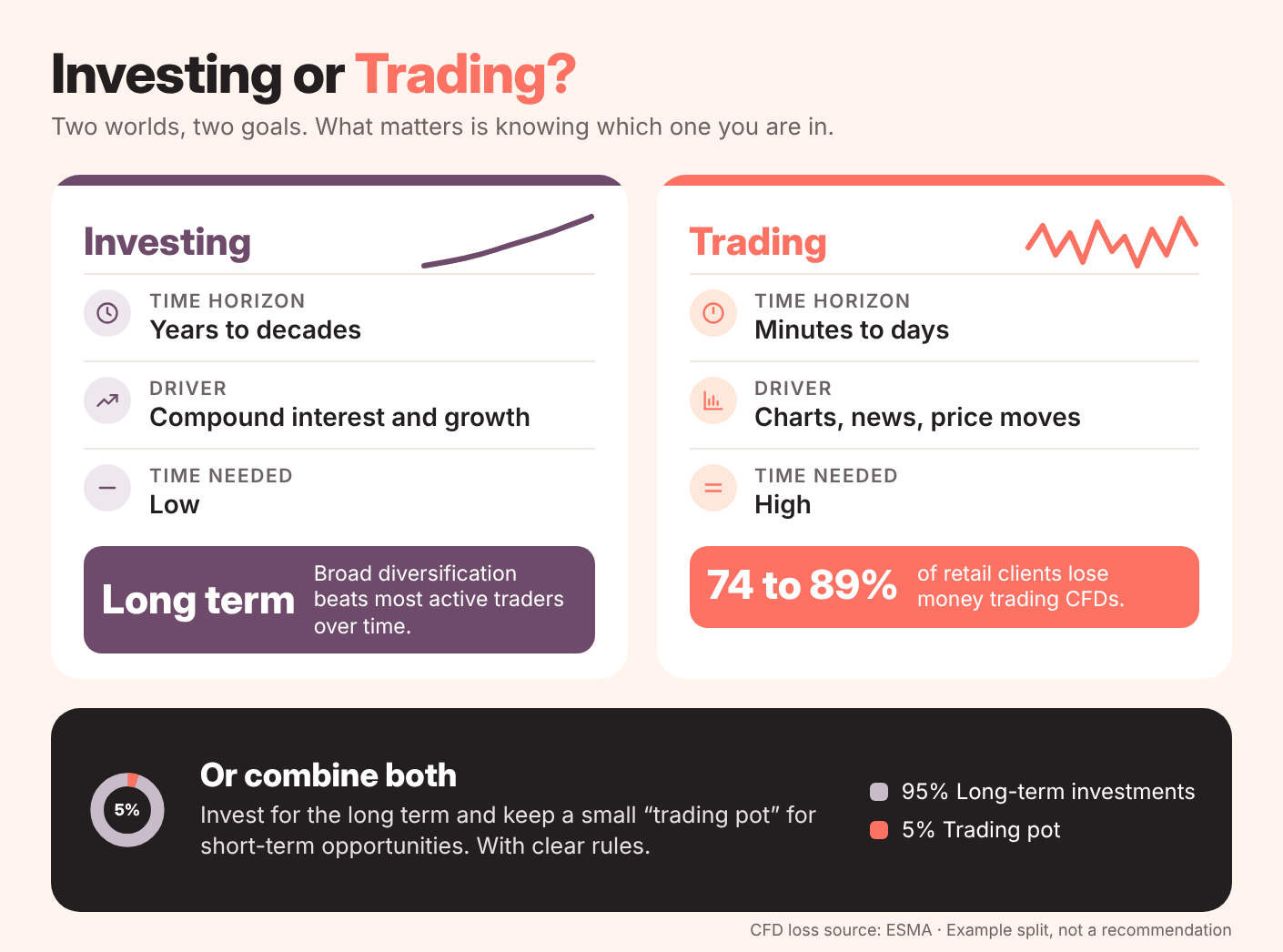
Investing means: you buy a share, an ETF or another asset and hold it for the long term, over years or even decades. You believe in the business model, want to share in its growth and let compound interest work for you. The focus is on building wealth over the long term, and short-term price swings do not concern you much. Studies show again and again: people who invest for the long term and diversify broadly beat most active traders over time. For most people with a job, a family and a life, who want to grow their wealth over the long term, this is the more realistic approach.
Trading means: you buy and sell shares, contracts for difference (CFDs) or futures over the short term, sometimes within minutes, hours or days. You analyse charts, news and price movements and try to profit from short-term moves. The focus is on short-term gains, which can be considerable. But: according to the European financial markets authority, around 74 to 89% of retail clients lose money trading CFDs (ESMA). Because they are up against algorithms, full-time professionals and, above all, their own psychology.
When does trading still make sense? If you enjoy the financial markets and have the time to deal with them often. If you understand the basics of the technology, charts, orders and stop-losses. If you want to make short-term gains. And if the capital you use can disappear completely without your life depending on it.
When is investing the better choice? Almost always, if you want to build wealth over the long term and do not want to check your portfolio every day.
Combining both worlds
One does not have to rule out the other. Many investors have long-term investments plus a “trading pot” of, say, 5% of their assets to take advantage of short-term opportunities. What matters most is that you are aware of which world you are in and what your goal is, and that you not only set clear rules for yourself but also stick to them. The most common mistake: you start investing, get nervous at the first market drop, try to somehow “time” the market and end up in limbo without meaning to.
Why Anthropic raises the question of trading vs. investing so clearly
Anthropic makes its money with the Claude models: through the API for developers and businesses, through subscriptions and enterprise contracts. And the business is growing fast: in the third quarter of 2026, Anthropic generated 17 billion dollars in revenue, more than twelve times as much as a year earlier (Anthropic IPO website).
At the same time, Anthropic reports a net loss of 23.3 billion dollars for the same quarter. That sounds dramatic, but most of it is purely an accounting entry: 21.9 billion of it arises because earlier financing, such as convertible notes, has become worth more due to the higher valuation. No cash actually flows out. In its core business, Anthropic was only slightly in the red.
The lesson: a net loss alone says little. Always look at where it comes from.
That does not mean Anthropic does not need money. Computing power for AI is enormously expensive. In the first half of the year, Anthropic spent almost 9 billion dollars on computing capacity and infrastructure, four times as much as the year before (Reuters via ARY News). And according to the prospectus, Anthropic has signed long-term computing commitments totalling around 895 billion dollars, spread over several years (Yahoo Finance).
So here too: science fiction is becoming commercial reality step by step, but at a high price and with many open questions. That is exactly why it pays to know, before you buy, whether you want to trade or invest here.
What the fine print says
The S-1 prospectus devotes around 90 pages to risks. That is normal for IPOs, because companies protect themselves legally. Still, it is worth a look, because some points are specific to an AI company (CNN, S-1):
- Computing power and commitments: around 70 of the almost 900 billion dollars in compute commitments fall due within twelve months (Yahoo Finance). This is set against a cash cushion of around 112 billion dollars, but the bill has to be covered by revenue over years.
- Competition and valuation: the high valuation assumes that growth continues while OpenAI, Google and Meta compete hard. (S-1)
- Misuse and control: Anthropic itself names the risk that AI could be misused for cyberattacks or dangerous purposes, or that AI agents could take unwanted actions. (S-1)
- Liability, regulation, geopolitics: lawsuits after AI-related harm, new laws, export restrictions and tensions between the US and China could hit the business. (S-1)
- Reputation and people: Anthropic positions itself strongly around AI safety. If these promises are not kept, it risks losing trust and staff. (S-1)
What SpaceX showed us
Historical data shows that big IPOs have two sides.
IPO pop: on the first trading day itself or shortly after, price swings are considerable. According to the long-term analysis by finance professor Jay Ritter (University of Florida), average first-day returns for US IPOs from 1980 to 2025 were around 19%, and as high as 31% for tech IPOs (Ritter, IPO Statistics).
In the long run, caution is advised: those who only bought at the first closing price and held for three years underperformed the market by around 20% on average (Ritter, IPO Statistics). This applies to the US market over several decades; individual IPOs can differ significantly.
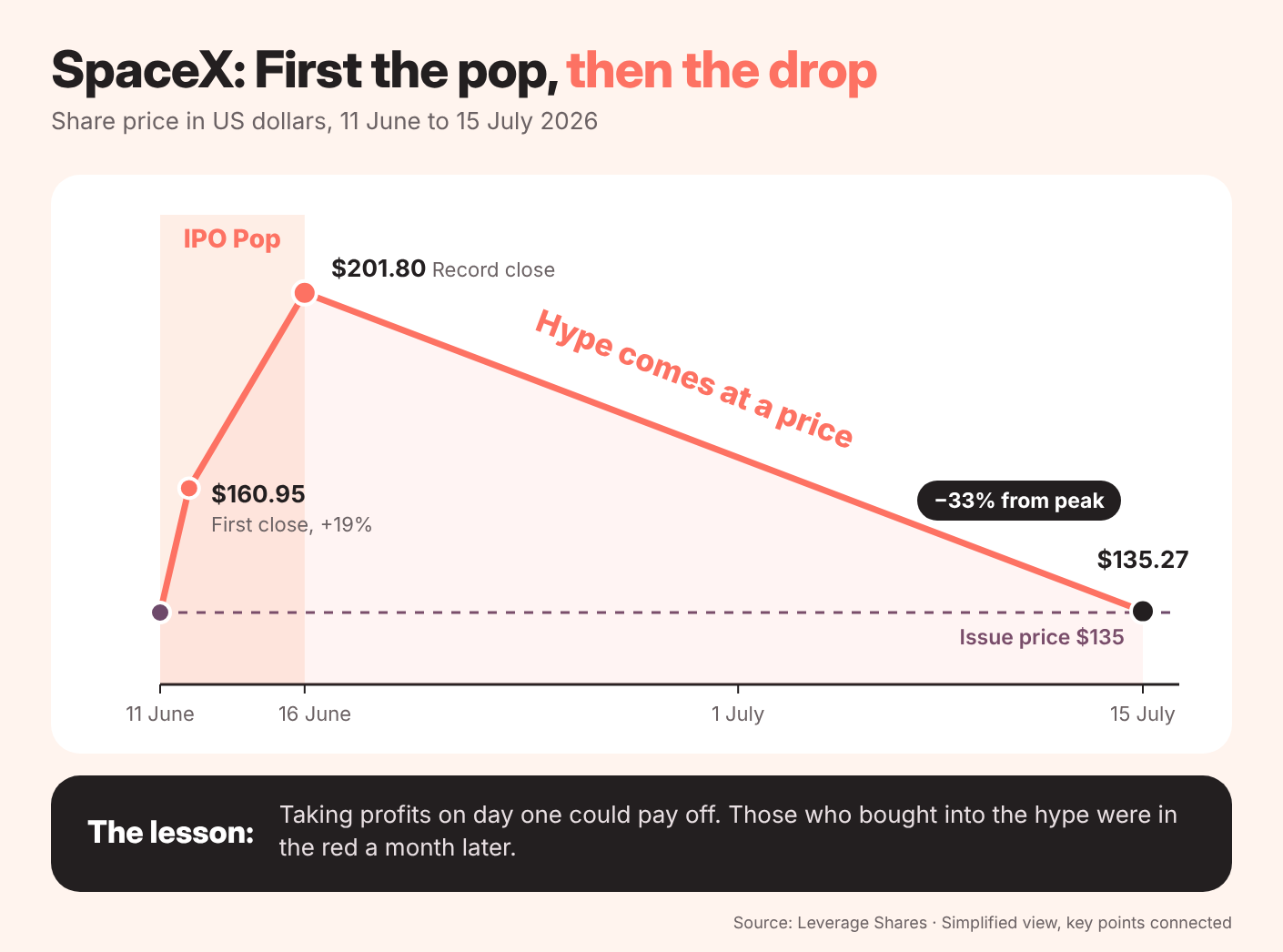
And then came SpaceX and showed both within a few weeks. Offer price on 11 June: 135 dollars. First closing price on 12 June: 160.95 dollars, up 19%, almost exactly the historical average. Then on 16 June, the record close of 201.80 dollars. And on 15 July the stock closed at 135.27 dollars, practically back at the offer price and 33% below the high (Leverage Shares).
So those who quickly took profits on the first day could benefit. Those who bought during the hype of the first week were sitting on a clear loss a month later. The euphoria of the first day comes at a price.
Nobody knows whether Anthropic will follow a similar path. The starting point is different: a different company, a different business model, and at around one trillion, the valuation is clearly lower than SpaceX's. But the pattern is a good reminder to be clear about your goal when you take part.
The questions you should ask yourself:
- Do I believe in Anthropic and want to hold the stock in my portfolio for the long term? Then it may make more sense to sit out the IPO hype, watch what happens, and only decide with more data once the market has shown what it thinks the company is worth.
- Do I want to profit in the short term and hope for an IPO pop? Then you should be ready on the first trading day and set yourself clear rules in advance for when you will sell.
How can you take part in the Anthropic IPO?
There are several ways, with very different opportunities and risks.
Option 1: Subscribing before the IPO
When you subscribe, you order shares at the offer price before trading starts. The advantage: you are in from the start for a possible IPO pop. The disadvantage: allocation is not guaranteed, and you often get fewer shares than you ordered.
The good news: this time it is also possible from Switzerland. Anthropic is making a public offer to retail investors in several countries, explicitly including Switzerland (Anthropic Help Center). In total, around 20% of the shares are to go to retail investors, significantly more than usual for IPOs (Yahoo Finance citing CNBC).
You can only subscribe through the brokers officially named by Anthropic. For the EEA and/or Switzerland, these are: BNP Paribas, Crédit Agricole CIB, Deutsche Bank, eToro, flatexDEGIRO, ING, Interactive Brokers, Nordnet, Revolut, Saxo Bank, Scalable Capital, Trade Republic and UBS Investment Bank (Anthropic Help Center). Which of them accept clients resident in Switzerland is best checked directly in your app.
What you need to know:
- The window is short. You can only subscribe until before the price is set. In EU countries, the deadline reportedly ends on 18 November at 4 pm (EU Personal Finance). Your broker may set an earlier deadline, so check today.
- Allocation is not guaranteed. With almost sevenfold oversubscription, you may only get part of your order or nothing at all. Even so, only order what you are really willing to pay for (Anthropic IPO website).
- You are buying a US share in dollars. Exchange rate and broker fees come on top.
- Beware of fraud. Anthropic states explicitly that no other companies or platforms are authorised to offer or promote shares from this offering (Anthropic Help Center). You should ignore offers via social media or unknown “pre-IPO” sites.
CFD providers such as IG Bank also offer bets on the price. However, this is not a subscription, but trading with all the risks of CFD trading.
Option 1b: Via a product even before the IPO
There are products that already track Anthropic's performance today:
- 21shares Anthropic Synthetic ETP (CLAU), ISIN CH1606386675: you do not own any shares, you only track the price movement. Costs 1% per year (21shares).
- Stableton Unicorn 20 AMC, ISIN CH1234846777: a tracker certificate on 20 unlisted companies, including Anthropic. It has performed well, but it comes at a price: around 2.18% ongoing costs plus entry and exit costs (Stableton).
For both: read the factsheet carefully. Such structures carry counterparty risk and work differently from a share.
And to be clear: these products are not an IPO subscription. They only track the performance and run independently of the official offering.
Option 2: Buying on the first trading day
From the first trading day, ANT can be traded on the Nasdaq like any other US share, via the usual brokers. Then you see the real market price.
Keep in mind: the Nasdaq opens at 3.30 pm Swiss time, but with a mega IPO the first price often only comes hours later. With SpaceX, the first trade only happened at 11.46 am New York time, around 5.45 pm here (Leverage Shares). And the first price can be far from the offer price (Leverage Shares). In practice, this means: keep your afternoon and evening free, be ready at your computer, work with a limit order and decide based on the situation.
Option 3: Wait and see
Let the hype die down. Watch the price. Understand the numbers. And buy in later, for example after the first earnings release as a listed company. SpaceX has shown that this does not have to be a bad strategy.
On top of that: the Nasdaq changed its rules this year. Large newcomers can now be added to the Nasdaq-100 after just 15 trading days (LPL Research). With a valuation of around one trillion dollars, Anthropic is likely to qualify. So if you have a Nasdaq-100 ETF savings plan today, you will automatically be on board sooner or later, whether you want to or not.
If the price falls after the IPO, you can buy in more cheaply. In return, you deliberately let the opportunity of the launch pass you by. If the stock does well, you buy in later at a higher level.
Option 4: Taking part indirectly
For anyone who wants exposure to Anthropic without buying the stock directly:
- Companies that already hold large stakes: Amazon and Alphabet have both been invested in Anthropic for years.
- Companies that earn from the build-out: Anthropic buys enormous amounts of computing power. Chip and infrastructure companies such as Nvidia, Broadcom or the data centre specialists Vertiv and Eaton benefit from this. Interesting: Nvidia, Broadcom, AMD, Micron, TSMC, Google and Microsoft will buy a total of 26 billion dollars of Anthropic shares at the IPO price as part of a private placement (Quartz).
With this approach you get more diversification and lower single-stock risk, but no direct Anthropic effect. These companies move mainly because of their own business.
So how could you go about it?
One possible approach for anyone with a trading pot: first check whether your broker is on the official list, and if so, subscribe for a small amount. If that does not work, you can try the IPO trade live on the first trading day and keep the afternoon and evening free for it. Not to bet everything on one AI company, but because you can trade live in both directions, with clear rules on when you sell. And if a pop looks unlikely: wait and be patient. If you have a Nasdaq-100 ETF savings plan, you will be on board sooner or later anyway.
Most important of all, though: if you do not feel comfortable with the trade, simply let the hype pass. There will be plenty of opportunities later, once more information and results have been published.
And you? Are you taking part in the Anthropic IPO, as a trader, as an investor, or are you just watching? 💰
-
Investing Mistakes: Why Our Minds Get in Our Own Way
Behavioural finance explains why even experienced investors make costly mistakes. See what the research shows and use a 30-second ... -
How to Read Your Swiss Pension Certificate: The 5 Key Numbers
What’s your relationship with the money in your pension fund? Do you see it as your wealth? Or is it money that disappears somewhe... -
Emergency Fund in Switzerland: How Much You Need and How to Earn More on It
How big should your emergency fund be, and where should you keep it? Calculate your number and compare smart ways to earn more on ...