Demographic Shift Investing: Trends Every Long-Term Investor Should Know

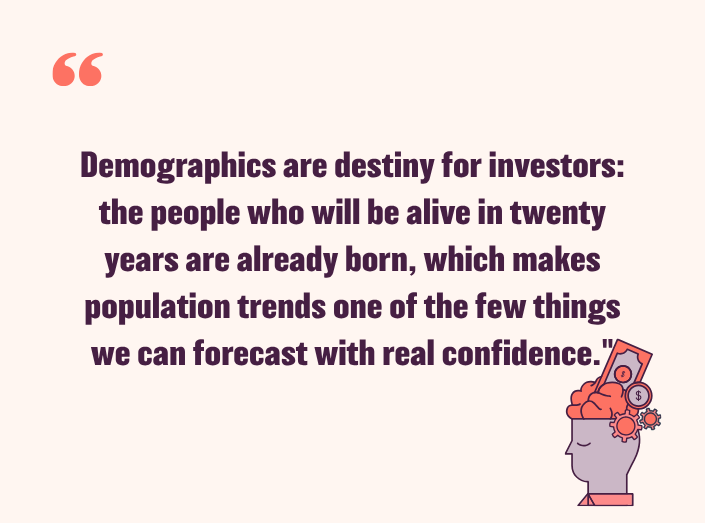
Most investment themes depend on things that are hard to predict — interest rates, politics, technology cycles, market sentiment. Demographics are different. Birth rates, ageing, and population growth unfold slowly and predictably over decades, which is exactly what makes them so powerful for long-term investors.

The "demographic shift" describes several overlapping trends: populations in developed countries are getting older, some are beginning to shrink, and at the same time large emerging economies are seeing young, growing, and increasingly prosperous populations.

Each of these shifts creates winners and losers across industries. For Swiss investors, exchange-traded funds (ETFs) offer a practical way to gain diversified exposure to these long-term changes without betting on individual companies.

Why Demographics Drive Long-Term Returns

Demographic change matters because it reshapes demand at a fundamental level.

When a large share of the population moves into retirement, spending patterns shift toward healthcare, insurance, pension products, leisure, and care services. When younger populations in emerging markets grow wealthier, demand rises for housing, consumer goods, financial services, technology, and education.

Because these shifts happen gradually and are already visible in the data, they give long-term investors a rare sense of direction. You don't need to guess whether the population will age — you only need to think about which companies and sectors are positioned to serve a changing world.

That predictability is why demographic investing has become such a popular lens for building resilient, forward-looking portfolios.

The Key Trends Within the Demographic Shift

Several distinct themes sit under the demographic umbrella, and it helps to understand them separately.

An ageing population and the "longevity economy." In much of Europe, North America, and East Asia, the share of people over 60 is rising rapidly. This fuels demand for healthcare, pharmaceuticals, medical devices, senior housing, insurance, and wealth management — the businesses that serve people in later life.

A shrinking workforce and the rise of automation. As working-age populations shrink in countries such as Japan, Germany, and Italy, companies are turning to robotics, automation, and artificial intelligence to stay productive. Demographic pressure is, paradoxically, one of the strongest tailwinds behind the automation theme.

A growing, younger emerging world. While developed economies age, many emerging markets have young and expanding populations. As incomes rise, a new middle class drives demand for consumer goods, financial services, digital technology, and infrastructure.

The silver economy. Beyond healthcare, older consumers represent a huge and often underserved market — from travel and leisure to financial planning and age-friendly products and services.

Recognising these threads helps you see that "demographic investing" isn't a single trade, but a family of related long-term opportunities.

How to Invest in the Demographic Shift

Several ETFs let investors gain exposure to these themes in a diversified way.

The iShares Ageing Population UCITS ETF is one of the best-known ways to invest directly in the longevity theme. It tracks a global index of companies expected to benefit from the growing needs of the world's ageing population, spanning sectors such as healthcare, pharmaceuticals, insurance, financial services, and consumer services. Because it spreads exposure across many industries and regions, it captures the breadth of the ageing trend rather than a single slice of it.

Healthcare ETFs are a natural complement, since an ageing world drives structural demand for medicines, treatments, and care. A broad global healthcare fund can serve as a core holding alongside a more focused demographic ETF.

To capture the other side of the demographic story — young, growing populations — investors often look to broad emerging market equity ETFs, which give exposure to the rising middle class and long-term consumption growth across developing economies.

A quick note for Swiss investors: some well-known longevity and ageing funds (such as certain Global X thematic ETFs) are listed in the United States and may be harder to access under European rules. UCITS-domiciled funds like the iShares Ageing Population ETF are generally the more practical route for investors based in Switzerland.

What Swiss Investors Should Consider

A few practical points are worth keeping in mind.

Demographic themes are long-term by nature. These are trends that play out over decades, so they suit patient investors rather than those looking for quick gains.

Diversification remains essential. Thematic ETFs work best as a complement to a broadly diversified portfolio, not as a replacement for global equity exposure. Concentrating too heavily in one theme increases risk.

Check what a fund actually holds. Two "demographic" or "ageing" ETFs can be built very differently, with different sector weights, regional exposure, and costs. Always review the index, holdings, and expense ratio.

And as with any thematic investment, keep expectations grounded — a powerful long-term trend does not guarantee a smooth ride.

Risks of Demographic Investing

Even the most predictable trends carry risks.

The direction of demographic change may be clear, but which companies benefit — and how much — is far less certain. A theme can be real while a specific fund still underperforms, for example if popular stocks become expensive or if a particular region disappoints.

Emerging market exposure adds currency risk and political risk. Automation and healthcare themes face regulatory and competitive pressures. And thematic funds can trade at elevated valuations when investor enthusiasm runs high.

For all these reasons, demographic investing is best approached as one long-term building block within a diversified strategy.

Final Thoughts

Demographics are one of the few forces in investing we can see coming. The world is ageing, workforces are shrinking in some regions and expanding in others, and a growing global middle class is reshaping demand — all at the same time.

For Swiss investors, ETFs make it possible to position for these shifts in a simple, diversified way, whether through an ageing-population fund, a broad healthcare holding, or emerging market exposure.

The key isn't to predict the future perfectly. It's to recognise the long-term direction of travel, understand what you own, and make sure your demographic allocation fits sensibly within your overall plan.

Upcoming events