
I still remember a conversation with a friend last year. She works 80%, her husband full-time. Together, they earn around CHF 150,000 and every time they file their taxes, the frustration hits:
“We pay more than the unmarried couple next door, even though we earn exactly the same.”
The so-called marriage penalty. Discussed for years, never fundamentally resolved.
Now it’s happened. On March 8, 2026, Swiss voters approved the federal law introducing individual taxation. The majority vote was achieved and with it, the system change is sealed. By 2032 at the latest, every adult in Switzerland will be taxed individually, regardless of marital status.
What that means in practice—for you, your partner, and your financial planning—is what we’ll walk through step by step.
The Old System: Why Marriage Could Hurt You Financially
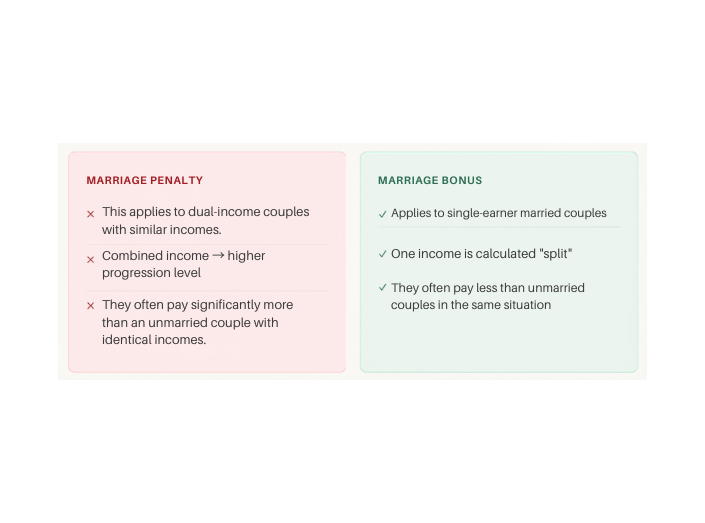
Until now, Switzerland taxed married couples jointly. It sounds simple—but there’s a major drawback: when two incomes are combined, you quickly move into a higher tax bracket. Taxes increase disproportionately.
This led to two well-known effects:
- The marriage penalty (higher taxes for married couples with similar incomes)
- The second-earner penalty (reduced incentives for the second partner to work more)
Both effects disappear under individual taxation. Marital status will no longer matter for tax purposes. That’s the idea—but like any system change, there are winners and losers.
What’s Changing: The Core Idea of Individual Taxation
The new system is simple in principle: each person is taxed individually. Income and wealth are no longer combined. The same tax rates apply to everyone—regardless of marital status.
Important to Know
The federal law is in place. Direct federal tax will fully switch to individual taxation. However, for cantonal and municipal taxes, Switzerland’s 26 cantons have flexibility in implementation—tax rates, deductions, and progression curves may vary.
What applies in Zug may differ from Bern or Geneva.
Timeline for Implementation
March 8, 2026
Public vote: Individual taxation approved.
2026–2031
Cantons adjust tax rates, deductions, and IT systems. The federal government coordinates via the Swiss Federal Tax Administration.
By 2032 at the latest
The new system comes into force. Every adult files their own tax return.
Who Wins – Who Loses?
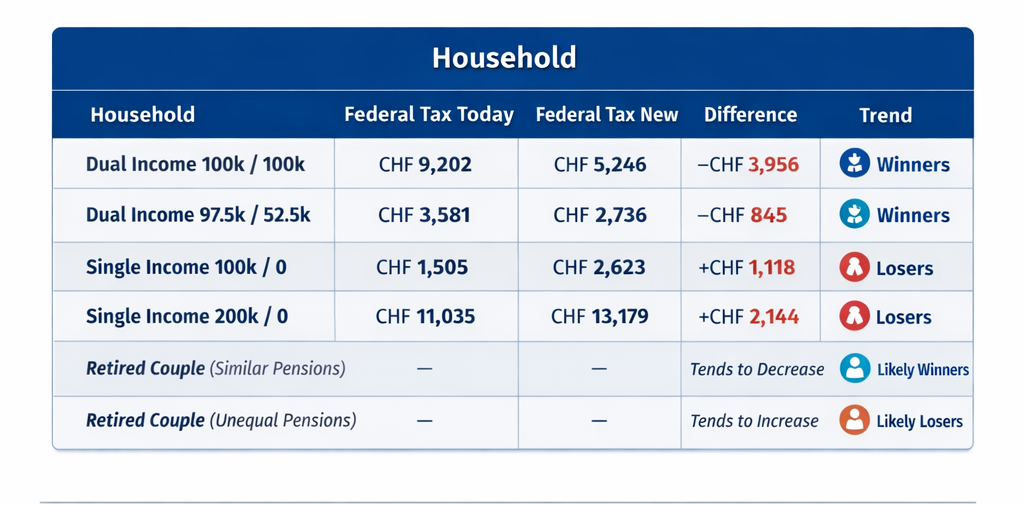
This is the key question—and the answer depends on your household structure. Below are real examples based on direct federal tax calculations.
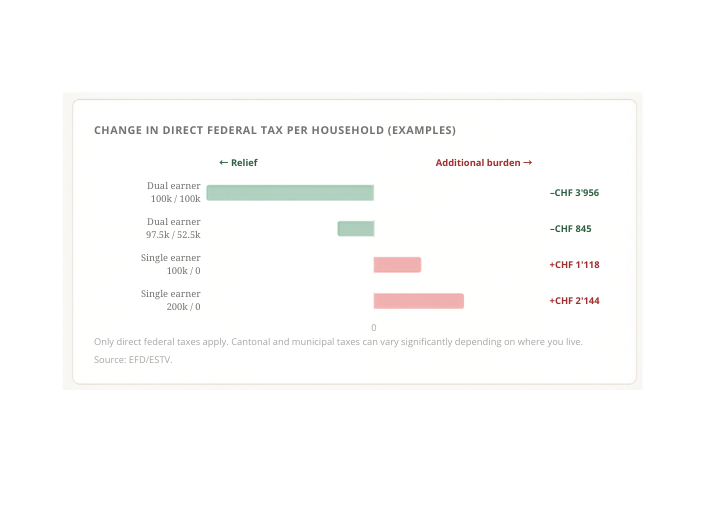
Scenario 1: Dual-income couple with similar earnings – big winners
Both partners earn CHF 100,000.
Today: combined income CHF 200,000 → high progression → CHF 9,202 tax.
Under the new system:
Each pays CHF 2,623 → total CHF 5,246.
Savings: nearly CHF 4,000 per year.
Scenario 2: Unequal incomes – moderate winners
One earns CHF 97,500, the other CHF 52,500.
Today: CHF 3,581 tax.
New: CHF 2,736.
Savings: around CHF 850.
Scenario 3: Single-income family – clear losers
One partner works, the other stays home.
Today, the “splitting effect” reduces tax:
→ CHF 1,505
New system:
→ CHF 2,623
Increase: over CHF 1,100 per year.
For higher incomes, the additional burden increases further.
Key Insight
This reform is not about favoring unmarried couples—it’s about equalizing taxation regardless of marital status. Some married couples benefit, others pay more.
What This Means for Married Couples
Beyond tax amounts, individual taxation changes how couples need to manage their finances.
1. Clearly Assign Wealth
Previously, wealth was combined. Now, each person has their own taxable assets.
Example:
Joint account with CHF 100,000
- Person A contributes 70%
- Person B contributes 30%
This split must now be documented for tax purposes.
2. Property and Mortgages: Who Carries What?
This becomes especially tricky.
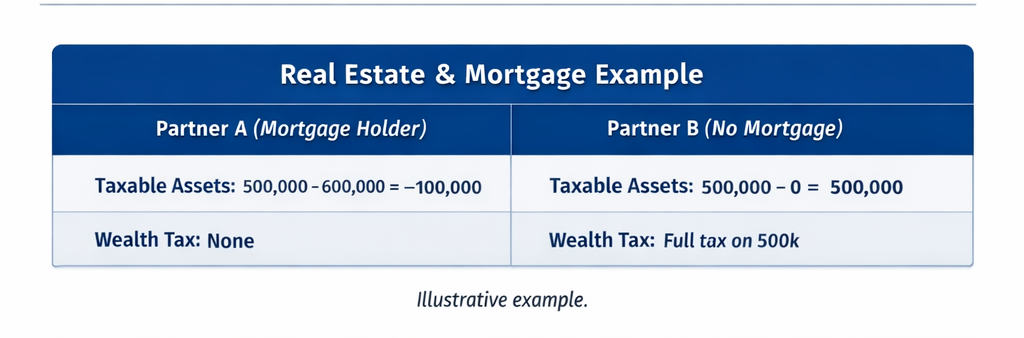
Example:
Property value: CHF 1,000,000 (50/50 ownership)
Mortgage: CHF 600,000 (in one person’s name)
- Partner A: negative net wealth → no wealth tax
- Partner B: CHF 500,000 net wealth → full wealth tax
This kind of outcome may surprise many couples.
3. Separate Tax Returns = More Responsibility
One joint tax return becomes two.
- More administrative effort
- Separate deadlines and access
- No joint signature
Each person is fully responsible for their own declaration.
4. Pension Pillar 3a and Occupational Pension (BVG)
Pillar 3a was always individual—but now:
- Tax benefits only reduce your own progression
- Not the couple’s combined tax burden
Each person needs their own retirement strategy.
BVG buy-ins also only benefit the contributing individual.
Administrative Challenges – And What It Means for You
The government estimates 1.7 million additional tax returns.
26 Cantons, 26 Implementations
Each canton adjusts its own:
- Tax rates
- Deductions
- Systems
This means differences across regions, especially during the transition.
Practical Implication
Check early which cantonal rules apply to you.
During 2026–2032:
- Tax systems will evolve
- Deduction opportunities may change
Delays could cost you tax advantages (e.g., pension contributions before year-end).
Digitalisation: Opportunity and Barrier
The new system requires:
- Digital tax accounts
- Understanding new processes
Easy for some—but challenging for others, especially less tech-savvy individuals.
What You Can Do Now
2032 may seem far away, but decisions today already matter.
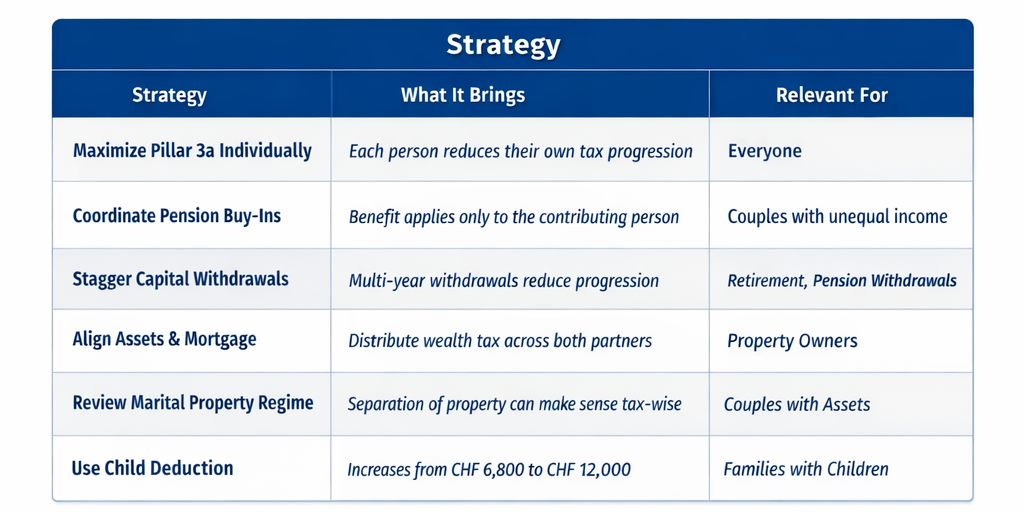
Key strategies:
- Maximise Pillar 3a individually → lowers personal tax rate
- Coordinate BVG buy-ins → optimise benefits
- Stagger capital withdrawals → reduce tax progression
- Align assets and mortgages → balance wealth tax
- Review marital property regime → separation of property may help
- Use child deductions → increased from CHF 6,800 to CHF 12,000
The Bigger Picture: A Value-Based Reform
Individual taxation is not just technical, it reflects a shift in values.
It:
- Promotes equal economic treatment
- Encourages workforce participation (especially for women)
- Removes long-standing inequities for dual-income couples
But it also:
- Increases taxes for single-income families
- Makes financial planning more complex
The government expects around CHF 630 million in lost revenue, which will need to be offset elsewhere.
Conclusion
If you’re in a dual-income household, this is a real financial advantage—don’t underestimate it.
If you’re a single-income household, it’s worth working with a tax advisor to offset the increased burden through:
- Pillar 3a
- Child deductions
- Pension planning
And if you’re an entrepreneur, individual planning of salary, dividends, and pensions becomes even more important.
Discover more
-
Steuererklärung stressfrei erledigen: Mit diesen Tools klappts
Die Steuererklärung gehört für viele zu den unbeliebtesten Aufgaben des Jahres. Zum Glück gibt es inzwischen digitale Tools und so... -
Exiting the investment—when is the best time to do so?
Einmal angelegt, wunderbar. Aber wann ist der «beste Zeitpunkt», um aus deiner Investition wieder auszusteigen? -
Smart All World ETP Explained (Switzerland’s New Investment)
One product, global markets and future-focused assets. The Smart All World ETP brings shares, bonds and alternatives together in a...